Showing posts with label semantic shift. Show all posts
Showing posts with label semantic shift. Show all posts
basket case
Why is an overly emotional, frantic person sometimes called a basket case?
The term basket case originated in the U.S. military to denote someone (esp. a soldier) who had lost all four limbs and was therefore unable to move independently. The term was later broadened to include those who could not support themselves emotionally or mentally.
[ 1, 4 ]
Categories:
1910,
semantic shift

Share this:


army fatigues
Why is the loose-fitting clothing worn by soldiers called army fatigues?
Army fatigues (such as those worn in the picture below) are donned by soldiers when performing menial, nonmilitary tasks. These tasks themselves were once referred to as fatigues, which is where the G.I. garb got its name (originally: fatigue dress, "outfit worn when performing fatigues").
The chores (and thus the clothing) were so-called for being tiresome and laborious.
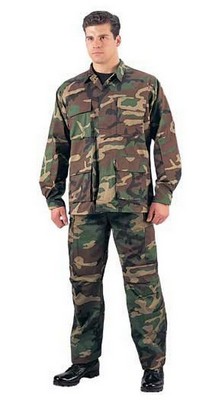
(Camouflage fatigues)
[ 1, 7 ]
Categories:
1830,
semantic shift
Share this:
barbie (grill)
At cookouts, why do Australian English-speakers often refer to the grill as the barbie?
Barbie is a shortened form of barbecue, another word for a grill. In fact, the word barbecue comes from Spanish barbacoa, "wooden frame on posts," originally referring to a wooden framework upon which a person could sleep, or where meat was stored to be dried.
[ 1, 4 ]
Categories:
abbreviations,
Australia,
semantic shift,
Spanish
Share this:
bagel (Jew)
Why are members of the Jewish population sometimes referred to derogatorily as bagels?
Today one of America's most popular breakfast items, bagels were introduced to the United States by Jewish-American immigrants, whose ancestors are credited with the invention of the popular bakery item back in Poland. The bagel is considered a staple of traditional Jewish-American cuisine, and its prevalence among Jewish communities in the New World gave rise to the metonymical racial slur.
The word bagel comes from the Yiddish beygl, which in turn is believed to derive from Old English bēag, "ring."
[ 4, 7 ]
Categories:
metonymy,
semantic shift,
U.S.,
Yiddish
Share this:
anchor (broadcast news)
Why is the host of a broadcast news program called an anchor?
Anchor is, of course, short for anchorman, but with the rise of women in the broadcast industry, the position was shortened to anchor to make it suitable for both genders.
Whether you prefer anchor or anchorman/woman, the term arose via semantic extension from the sense of "the strongest runner (or swimmer) on a relay team." This use, in turn, is speculated to have its roots in the anchor man positioned at the end of a tug of war, but this connection has not been proven.

(San Diego's classiest news anchor.)
[ 1, 3 ]
Categories:
1930,
semantic shift
Share this:
scalp (tickets)
Why is the resale of tickets called scalping?
It was the practice of some Native American tribes to scalp their defeated foes (that is, to remove the skin from the tops of their heads). These scalps were originally collected as trophies and served as a formidable attestation to a combatant's prowess in battle. Eventually, scalping became financially motivated as well, with individuals receiving payment for each scalp procured.
As settlement on the American frontier continued, rail travel quickly grew in popularity. Men saw an opportunity to make quick cash by purchasing unused portions of railroad tickets to resell for profit. These traders in tickets came to be compared with collectors of scalps, and soon the term scalper was extended to include these ticket tradesmen as well.
Scalpers eventually expanded their domain of resale beyond railroad tickets. Today, we encounter offers to buy scalped tickets for just about every event imaginable.
[ 10 ]
Categories:
1860,
semantic shift
Share this:
runner-up
Why is the second-place finisher in a competition called the runner-up?
The term runner-up comes from the dog track, where it referred to the hound that finished second in the final heat. An explanation dating back to 1890 states that "the dog last running with the winner is called the runner-up because he ran through the races up to the last race without being defeated once."
[ 11 ]
Categories:
semantic shift
Share this:
Subscribe to:
Posts (Atom)


