chutzpah


Why is someone with shameless audacity said to have chutzpah?

Balls, cheek, nerve, brass — all synonyms for this wonderfully phlegmy Yiddish word defined by lexicographer Leo Rosten as "that quality enshrined in a man who, having killed his mother and father, throws himself on the mercy of the court because he is an orphan." With etymological roots going as far back as the Aramaic ḥu ṣpā evolving into the Hebrew verb khátsap “to be insolent,” we are gifted with this decidedly Jewish term whose phonetic quality itself exudes well-warranted disgust.

Varient spellings: chutzpa, hutzpah, hutzpa

Etymological journey: ḥu ṣpā (Aramaic) → khátsaphutspah (Heb.) → khutspe (Yiddish)

[ 1, 4, 7 ]

pot (cannabis)


Why is marijuana sometimes called pot?

Pot is most likely a shortening of the Mexican Spanish word potiguaya, "marijuana leaves."


[ 7 ]

alcohol


Alcohol comes from the Arabic word al-kuhl, meaning "the kohl." Kohl (antimony sulfide) is a black powder that was widely used as eye makeup in the Middle East around 800 A.D.

Kohl is the earliest known distillate. When a curious Arab set out to determine what exactly was in wine that made it so intoxicating, he distilled al-kuhl as part of his experiments and ended up with a highly refined spirit.

[ 1, 3 ]

adult vs. adultery


Yes, technically adultery is committed by adults, but the connection between these two words ends there.

Adultery comes from the Latin word adulterare, "to pollute or corrupt," while adult comes from the Latin verb adolescere, meaning "to grow up."

adolescere = to grow up

adolescens (present tense) = grows up

adultus (past tense) = grew up


So there you go — an adult is someone who has finished growing up, and an adulterer is someone who pollutes or corrupts.

The air pollution in Manhattan is horrendous.
There must be a lot of adulterers there...

[ 3, 9 ]

beef (wipeout)


Why is someone who has taken a bad fall said to have beefed?

Especially common in skater vernacular, the term beef—meaning a bad fall or wipeout—comes from the original sense of slaughtering an animal for beef, a similarly gruesome outcome.

(Skater majorly beefs.)
[ 4 ]

beef (complaint)


Where did such phrases as "to have a beef with someone" or "what's your beef?" ever arise?

This one remains a minor etymological mystery. Beef, meaning "a complaint," can be traced back to the original slang to cut a beef, likewise denoting the act of complaining. But our knowledge of the term ends there.

It has been suggested that the beef in question alludes to the "bone of contention" from which it was cut.

[ 14 ]

basket case


Why is an overly emotional, frantic person sometimes called a basket case?

The term basket case originated in the U.S. military to denote someone (esp. a soldier) who had lost all four limbs and was therefore unable to move independently. The term was later broadened to include those who could not support themselves emotionally or mentally.

[ 1, 4 ]

pencil skirt


This slim-fitting skirt is named for its pencil-straight appearance. The designer Christian Dior originally used the term "H-line" to describe its shape, distinguishing it from the full-skirted "A-line" style (after the relative shapes of the letters "H" and "A").

    
(Two examples of contemporary pencil skirts.)
[ 0 ]

paddy wagon


Why are police vans sometimes referred to as paddy wagons?

Paddy, short for the Irish name Pádraic (or Patrick), was once a common pejorative form of address for an Irishman. The prominent theory is that the term paddy wagon arose at a time when Irish-Americans constituted a large percentage of the police force in many major cities, to the point that "police" and "Irish" were largely synonymous.

(Paddy wagon, 1909)

(Modern paddy wagon)
[ 1 ]

mullet


"Business in the front, party in the back"

The name of this oft-ridiculed hairstyle was vaulted into popular American culture after the musical group The Beastie Boys released the song "Mullet Head," lampooning the ridiculous 'do. A year later, the band also ran an article in their self-published magazine Grand Royal titled "Mulling Over the Mullet."

While the Beastie Boys are often credited with coining the term mullet, the origin of the word is actually uncertain. It has been suggested that it bears a relationship with the 19th-century insult mullet-head, "a stupid person." Another humorous possibility is that it derives from the now-obsolete verb mullet, "to pluck with tweezers."

[ 1 ]
(Click the 'play' button to hear the Beastie Boys "Mullet Head" while gazing upon gorgeous mullet mugshots.)

autism


The name of the mental condition was coined by Swiss psychiatrist Eugen Bleuler, who called it autismus (from Greek autos "self" + ismos "an action or state") after the symptomatic "morbid self-absorption" exhibited by those afflicted.

[ 1, 7 ]

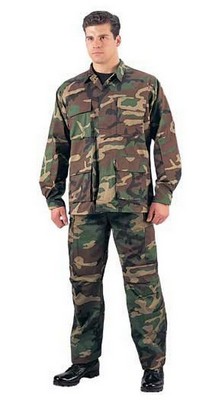
army fatigues


Why is the loose-fitting clothing worn by soldiers called army fatigues?

Army fatigues (such as those worn in the picture below) are donned by soldiers when performing menial, nonmilitary tasks. These tasks themselves were once referred to as fatigues, which is where the G.I. garb got its name (originally: fatigue dress, "outfit worn when performing fatigues").

The chores (and thus the clothing) were so-called for being tiresome and laborious.

(Camouflage fatigues)
[ 1, 7 ]

barbie (grill)


At cookouts, why do Australian English-speakers often refer to the grill as the barbie?

Barbie is a shortened form of barbecue, another word for a grill. In fact, the word barbecue comes from Spanish barbacoa, "wooden frame on posts," originally referring to a wooden framework upon which a person could sleep, or where meat was stored to be dried.

[ 1, 4 ]

bagel (Jew)


Why are members of the Jewish population sometimes referred to derogatorily as bagels?

Today one of America's most popular breakfast items, bagels were introduced to the United States by Jewish-American immigrants, whose ancestors are credited with the invention of the popular bakery item back in Poland. The bagel is considered a staple of traditional Jewish-American cuisine, and its prevalence among Jewish communities in the New World gave rise to the metonymical racial slur.

The word bagel comes from the Yiddish beygl, which in turn is believed to derive from Old English bēag, "ring."

[ 4, 7 ]

AT&T


The name of the large U.S. phone company stands for American Telephone & Telegraph.

[ 3 ]

asteroid


Also sometimes referred to as minor planets, asteroids get their name from the Greek word asteroeidēs, "starlike" (astēr, "star" + eidos, "form").

Literally: "starlike"

[ 1, 3 ]

asterisk ( * )


Why is the small star used by writers and editors called an asterisk?

Asterisk ( * ) comes from the Greek word asteriskos, "small star," the diminutive form of astēr, "star."

Literally: "little star"

[ 1, 3 ]

Area 51


Why is the U.S. Air Force base associated with UFO sitings and extraterrestrial contact referred to as Area 51?

Area 51 is part of a secretive military base in southern Nevada dedicated to the testing of experimental military aircraft and weapons by the United States Air Force. The large Nevada test site is mapped according to a grid system, and the specific area in which UFO activity is purported to have taken place falls within grid number 51.

[ 0 ]

April Fool's Day


Why is the April 1st holiday of pranks called April Fool's Day?

The origin of this tradition (and its name) is not known. Several theories behind the name exist, however, including a misunderstood line from Chaucer's Canterbury Tales ("Syn March bigan thritty dayes and two," meaning "thirty-two days after March," was misinterpreted as "March 32nd"), and a reference by the French poet Eloy d'Amerval to poisson d'avril, "April fool" (literally "April fish").

The day was originally called April Fool Day.

[ 1 ]

apple-pie order


The phrase apple-pie order, referring to a state of prim and precise orderliness, is perhaps a corruption of the French nappes pliées, "(neatly) folded linen," or cap-a-pie, "head-to-toe." Yet neither of these bastardizations have been proven.

Apple-pie order, therefore, remains a mystery.

[ 3 ]